What Are Horse Racing Silks?
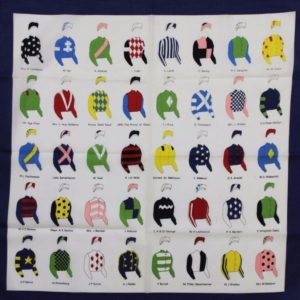 They help identify each horse in a race, the owner choosing their design such as shapes and colours. This consists of a top and cap. The cap may be a different colour and design from the top.
If an owner has more than one horse in a race they are often identified by a different colours cap such as white, red or blue.
The practice of using racing silks originated in England.
Horse racing silks are not a new idea and date back to the 12th century. However, many historians assign them around the date of 1515 when Henry VIII was king. In the 17th – 18th century is was more customary for jockeys to wear colourful silks.
You can design your own unique racing silks via a number of companies (such as Gibson Saddlers) however the guidelines for these are outlined by the British Racing Authority. This detail a set of 18 colours to choose from with a variety of shapes and designs. They can be made of crepe satin or pure silk.
Racing silks may be registered annually, or every 5, 10 or 20 years.
Some of the most famous horse racing silks have been sold.
It is reputed that the royal blue silks of Godolphin were originally in the ownership of Alan Bailey. Simon Crisford, now a horse trainer but originally racing manager for Godolphin, was said to have contacted Bailey to buy the silks for £500. However, following negotiations between the two Sheikh Mohammed wrote a cheque for £26,000. A lot of money in the 1980s, now seemingly a giveaway in these modern times.
What would your racing silks look like?
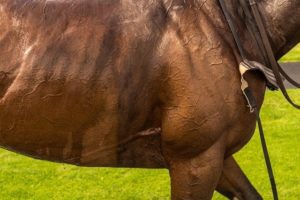 Generally speaking, sweating in racehorses is a good sign insofar as it helps to regulate body temperature. The evaporation of sweat, which is 90% water, creates a cooling effect, known as evaporative cooling, which lowers the body temperature. Of course, racehorses have a thick, waterproof, hairy coat, so their sweat contains a protein, known as latherin, which accelerates the transfer of sweat from the skin to the surface of the hair. When subject to friction, from girths, reins, etc, latherin can cause foaming, or lathering, of the sweat. Sweating can also reflect the physical condition of a racehorse. The fitter the horse, the better it becomes at regulating body temperature and the more readily it sweats.