What is a ‘Listed’ race?
In British Flat racing, the highest quality races are assigned Group One, Group Two or Group Three status by the European Pattern Committee. In British National Hunt racing, the grading system is similar, but races are assigned Grade One, Grade Two or Grade Three status by the Jump Pattern Committee, under the auspices of the British Horseracing Authority (BHA).
Under both codes, ‘Listed’ status represents a step below Group Three, or Grade Three, status, in terms of quality and, therefore, a step above handicap races. Like Group or Graded races, Listed races are run off level weights, with penalties for horses that have won at a higher level and allowances for age and gender. Thus, while Listed races are not subject to any minimum requirement, in terms of official handicap rating, they are more highly regarded than handicaps, in which every horse, theoretically, has the same chance of winning. Indeed, Listed races are the lowest level at which horses can earn so-called ‘black type’ in sales catalogues.
Dozens of Listed races, under both codes, are run throughout the year in Britain. Examples include the Windsor Castle Stakes and Chesham Stakes, at Royal Ascot, the Contenders Hurdle at Sandown
and Scottish Triumph Hurdle Trial at Musselburgh, to name but a few.
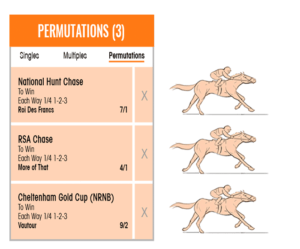 Not to be confused with a ‘Round Robin’ tournament, in which each participant plays every other participant, a ‘Round Robin’ bet is a multiple bet, which combines three selections in ten individual bets. Those individual bets are three doubles, one treble and three ‘single-stakes-about’ bets, each of which is actually a pair of bets. The doubles and treble are straightforward enough, but the single-stakes-about bets can be a source of confusion for anyone unfamiliar with ‘any-to-come’ or ‘if-cash’ betting.