Which British racecourse has the longest circuit?

The British racecourse with the longest, uninterrupted circuit is Pontefract in West Yorkshire. Pontefract, which has no straight course, is a left-handed, undulating oval, 2 miles and 125 yards in circumference. Pontefract was established in 1790, but has undergone major redevelopment more than once in its history. As far as the layout of the course is concerned, in April, 1983, the original horseshoe, approximately a mile and a half in extent, was extended to form a complete oval, with no gaps or chutes.

Indeed, Pontefract now stages the aptly-named Pontefract Marathon Handicap, over a distance of 2 miles 5 furlongs and 139 yards, in April each year. The longest Flat handicap run in Britain, the Pontefract Marathon Handicap is just four yards shorter than the Queen Alexandra Stakes, a condition stakes race run at Royal Ascot, which has the distinction of being the longest Flat race run under rules not only in Britain, but anywhere in the world.

With pronounced undulations and a sharp turn into the home straight, which is only two furlongs long, Pontefract Racecourse can hardly be described as ‘galloping’. However, the last three-quarters of a mile is essentially uphill, steeply so for the final three furlongs, so the emphasis is very much on stamina. Sprint races are run around a left-hand bend, but any draw bias in these races is minimal.
 

Did suffragette Emily Davison commit suicide?

Emily Wilding Davison became a martyr to the suffragette cause when, on June 4, 1913, she was struck, and fatally injured, by the King’s horse, Anmer, during the running of the Derby at Epsom. Her intentions in dashing onto the racecourse as the backmarkers rounded Tattenham Corner are not entirely clear, but she was knocked unconscious and died at Epsom Cottage Hospital four days later from a ‘fracture at the base of the skull’ without regaining consciousness.

Various hypotheses have been proposed to explain her behaviour. Some eyewitnesses suggested that Davison ran out in a reckless suicide attempt, others that she attempted to bring down Anmer. Subsequent analysis of contemporary newsreel footage, though, suggests that she was, in fact, attempting to advertise the ‘Votes for Women’ campaign by tying a banner, or flag, to the bridle of a half-tonne racehorse galloping at full speed.

Indeed, following the tragic accident, two such banners were found on her body. The fact that Davison and fellow suffragettes were reportedly seen practising tackling horses on Morpeth Common beforehand adds weight to this argument. Historians have also pointed out that Davison was in possession of an expensive return ticket for her travel to Epsom Downs and had written a postcard to her sister, Letitia, about a proposed visit to Paris shortly afterwards.

Which Group One races are run at Royal Ascot?

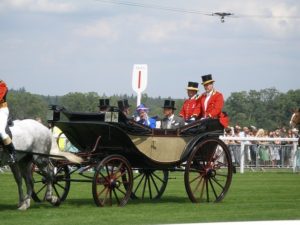
Which Group One races are run at Royal Ascot?  Royal Ascot is, of course, a highlight of the British sporting and social calendar. Remarkably, though, as recently as 1999, the Royal Meeting featured just three highest category, Group One races. Those races were the St. James’s Palace Stakes, Gold Cup and Coronation Stakes.

However, in the interim, several races have gained, or regained, Group One status and, in 2015, Royal Ascot was extended from four days to five to celebrate the Golden Jubilee of Queen Elizabeth II. At that point, a new Group One race, the Commonwealth Cup, run over six furlongs and restricted to three-year-olds, was added to the programme, making a total of eight in all.

In addition to the aforementioned races, the Prince of Wales’s Stakes was upgraded to Group One status in 2000, as were the Diamond Jubilee Stakes, formerly the Cork & Orrery Stakes, in 2002 and the Queen Anne Stakes in 2003. In 2005, the King’s Stand Stakes, which had previously held Group One status between 1973 and 1988, before being downgraded, became part of the so-called ‘Global Sprint Challenge’. As such, the five-furlong contest attracted a strong international entry, as a result of which it was upgraded to Group One status again in 2008.

Which British racecourse was the first to stage National Hunt racing?

In the summer of 2014, Jockey Club Racecourses, which owns Warwick Racecourse, announced that, from 2015 onwards, only National Hunt fixtures would be staged at the picturesque West Midlands venue. While not quite going full circle, Warwick was, in fact, the first British racecourse to include a hurdle race in its programme, as recorded in the Racing Calendar, in 1831.

Established in its current location in 1707, in recent years Warwick Racecourse has been better known for its National Hunt races, especially steeplechases, in any case. Seasonal highlights include the Grade 2 Kingmaker Novices’ Chase, run over 2 miles in February, and the Grade 3 Classic Chase, run over 3 miles 5 furlongs in January; the latter serves as a trial for the Grand National.

Ian Renton, Regional Director at the Jockey Club, said that Warwick could ‘now benefit from a clear identity’ but, following the fatal fall of Artful Lady in a six-furlong handicap in May, 2014, racecourse officials had already said that they had ‘lost confidence’ in portions of the Flat course. Veteran National Hunt trainer Nicky Henderson described Warwick as the home of ‘good, competitive jumps racing’ and welcomed the Jockey Club Racecourses’ decision as ‘a huge benefit’ to the sport.

1 2 3 4 5 6 9