Are three-year-old fillies eligible to run in the 2,000 Guineas & the Derby?

The simple answer is yes, they are. Although the 2,000 Guineas and the Derby as billed as “colts'” Classics, they are, in fact, open to horses of both sexes, but not geldings.The only proviso is that horses have run at least once and achieved an official handicap rating of 80 or more, or an equivalent level of form, in the eyes of the official handicap. In both cases, fillies receive a 3lb allowance from their male counterparts.

Three-year-old fillies may be eligible to run in the 2,000 Guineas and the Derby but, nowadays, rarely do so. Indeed, the last filly to win the 2,000 Guineas was Garden Path who, in 1944, justified favouritism in a wartime renewal, run on the July Course, rather than the Rowley Mile, at Newmarket. The last filly to win the ‘Derby’ was Fifinella who, in 1916, won a wartime substitute, known as the ‘New Derby Stakes’ also, coincidentally, run on the July Course at Newmarket.

Modern trainers prefer their top-class fillies to pursue the 1,000 Guineas and/or Oaks route, not least because both “fillies'” Classics are restricted to three-year-old fillies only. Notwithstanding funding cuts due to the Covid-19 pandemic, the 1,000 Guineas and 2,000 Guineas are worth exactly the same prize money and, although the premier colts’ Classic, the Derby, offers a purse three times higher than the Oaks, fillies have a much better chance of winning against their own sex.
How many times was Pat Eddery Champion Jockey?

Sadly, Patrick James John ‘Pat’ Eddery succumbed to alcoholism before dying, prematurely, at the age of 63, in November, 2015. However, he enjoyed a long, illustrious career, spread over the course of five decades, during which he rode 4,633 winners in Britain and became Champion Jockey 11 times. Indeed, since 1840, only Nat Flatman, George Fordham, Fred Archer and Sir Gordon Richards have won more jockeys’ titles and only Sir Gordon Richards has ridden more winners.

Born in Newbridge, Co. Kildare on March 18, 1952, Eddery began his riding career as apprentice to Seamus McGrath in 1966, before moving to England and joining Prestbury trainer Herbert ‘Frenchie’ Nicholson the following year. Having finished fourth and second in the apprentices’ table in his second and third full seasons, 1969 and 1970, he finally became Champion apprentice in 1971.

Two years later, he succeeded Duncan Keith as stable jockey to Lambourn trainer Peter Walwyn, in which capacity he would become Champion Jockey four years in a row between 1974 and 1977. During his time with Walwyn, Eddery rode his first three British Classic winners, Polygamy in the Oaks in 1974, Grundy in the Derby in 1975 and Scintillate in the Oaks, again, in 1979.

The following year Eddery left Walwyn to succeed Lester Piggott as stable jockey to Vincent O’Brien at Ballydoyle, Co. Tipperary and, later in his career, rode as retained jockey for Khalid Abdullah and as a freelance jockey. All told he won 14 British Classics and rode at least a hundred winners in Britain every year between 1973 and 2001, except 1982, when he was Champion Jockey in Ireland.

Which horse won the inaugural Cheltenham Gold Cup?

By way of clarification, by ‘Cheltenham Gold Cup’ we mean the Cheltenham Gold Cup in its current guise, as a steeplechase, which was first run on March 12, 1924, rather than the three-mile Flat race, which was first run at nearby Cleeve Hill, rather than Prestbury Park, over a century earlier. Nowadays, the Cheltenham Gold Cup is the most prestigious contest in National Hunt racing but, in its early days was overshadowed by other races, notably the National Hunt Chase.

Nevertheless, the inaugural running was covered by British Pathé News, under the title ‘Chasing’s Ascot’, and produced a thrilling finish. The eventual winner, Red Splash, trained by Fred Withington and ridden by Dick Rees, edged his nearest pursuers, Conjuror II and Gerard L by a neck and a head and won the princely sum of £685 for his trouble.

As a footnote, the original Cheltenham Gold Cup presented to winning owner Major Humphrey Wyndham, which consists of nearly a pound-and-a-half of nine carat gold, plated with 18 carat gold, was returned to Cheltenham Raecourse by its previous owner in 2018; since 2019, it has been presented to winning connections as a perpetual trophy.

Which was the first horse to run in the Kentucky and Epsom Derbies?

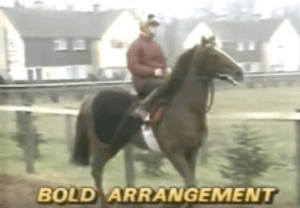
Which was the first horse to run in the Kentucky and Epsom Derbies?  The first horse to run in the Kentucky and Epsom Derbies and, indeed, the first British-trained horse to run in ‘The Race for the Roses’, was Bold Arrangement, owned by Anthony and Raymond Richards and trained, in Newmarket, by Clive Brittain. Brittain was renowned for his adventurous, pioneering spirit and, although often accused of ’tilting at windmills’, became synonymous with high-profile success at home and abroad.

Bold Arrangement was sired by Persian Bold, a smart performer between a mile and a mile-and-a-quarter, including on turf. He won four of his nine starts as a juvenile, including the Group Three Solario Stakes, over 7 furlongs, at Sandown Park, under Pat Eddery. After a modest three-year-old debut at Doncaster in March, 1986, Bold Arrangement headed to Lexington, Kentucky for his first start on dirt, the Blue Grass Stakes, over nine furlongs, at Keeneland. Once again ridden by Pat Eddery, the colt came from way off the pace to finish third, beaten three-quarters of a length.

At Churchill Downs, Bold Arrangement was ridden by Kentucky Derby veteran Chris McCarron, deputising for the suspended Eddery, and sent off at 8/1. After four furlongs, Bold Arrangement was only eleventh of the sixteen runners, but loomed large leaving the far turn and kept on stoutly to finish second, beaten 2¼ lengths, behind Ferdinand. McCarron kept the ride at Epsom a month later but, sent off at 12/1, Bold Arrangement could only manage fourteenth of the sixteen finishers behind controversial winner Shahrastani.

1 149 150 151 152 153