What’s an accumulator?
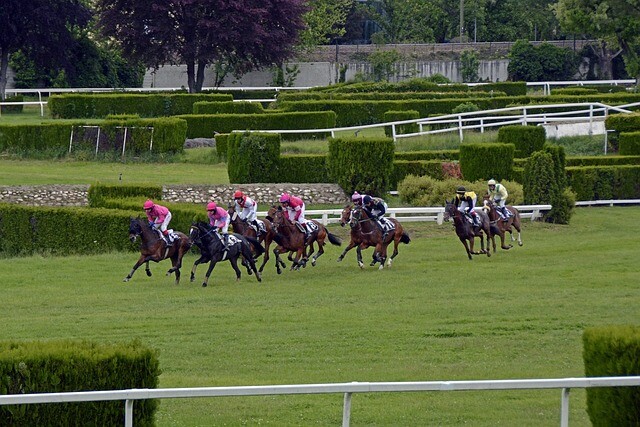
What's an accumulator?  In horse racing, an accumulator is a collective bet on selections in successive races, usually four or more. If the first selection wins, the initial stake and winnings are carried forward to the second selection and so on, such that potential winnings ‘accumulate’ progressively until the end of the bet is reached. For example, if you place a 1-point accumulator on four selections, each at 1/1, or even money, your potential winnings will be 2 x 2 x 2 x 2 = 16 points.

By it’s very nature acca bets are not easy to pull off, and so they can either be seen as a punt of a ‘lottery style’ punt, or alternatively some do their research or even go the horse racing AI route of analysing data and making comparisons in order to draw the most strategic and fact based conclusions possible.

An accumulator is an ‘all or nothing’ bet, so if one of your selections loses, you will lose your stake, regardless of the outcome of the other three races. Consequently, unless you’re in search of a huge return for a relatively small outlay, an accumulator is best suited to horses at prohibitively short odds, which are uneconomical to back individually. Of course, it’s possible to place an ‘accumulator’ on two or three successive races but, in horse racing parlance, the former is usually referred to as a ‘double’ and the latter as a ‘treble’.

Horse racing of course isn’t the only sport where accumulator bets loom large. Football is well known to have gifted punters many a big bucks acca win over the years. Some of course go for win bet combos, others over/under and the like, and the very same ai football tips angle is now an option, in the raced paces world of form and bet analysis. Don’t get left behind.

What does 2026 have in store for horse racing fans?

What does 2026 have in store for horse racing fans?  There was certainly no shortage of unmissable racing moments for UK fans of the sport of kings this year. We saw an impressive win from the Willie Mullins trained Nick Rockett in the Grand National in April, the 150-1 Outsider Qirat proving to be a massive upset in by beating Rosallion in the Sussex Stakes in July, and equally impressive 200-1 (Powerful Glory) and 100-1 winners (Cicero’s Gift) at British Champions Day in October. Some thankful punters clearly made bank! With such a packed year in terms of betting and feature events, what you may ask, does 2026 hold for horse racing fans, and how best to monopolise on the opportunities that present themselves?

Let’s start by narrowing down some of the big UK racing festivals that even casual racing fans tune in for. We’re talking about the likes of the Grand National, Cheltenham Festival (who doesn’t love the Gold Cup!), and the Epsom Derby. Of course betting markets aren’t fully fleshed out as of yet, but it never hurts to take a view early. The plus side of that is that sometimes you can steal a march on other punters and get odds that down the line may well seem like a dream.

This could be when you hit your first stumbling block though. How many times have you heard a friend or someone online say that they’re had their betting account shut down for winning!? On the surface it sounds ludicrous but I can very much assure you that it routinely happens. As consequence many looking to have a flutter now go the betting broker route, taking the personal hassle out of choosing a highstreet bookmaker and hoping that it’s all going to be trouble free (then facing problems when it isn’t). With brokers you’re essentially leaning on their knowledge of the betting world and network of accounts in such a manner that you can just ‘get on with it’, as in betting and winning. Of course, not all bookmakers give people problems anyway, but it can pay to have a stable, stress free approach to putting your bets on, and that’s often for serious gamblers where brokers step in, getting you the best odds, bypassing betting wager limits and so on.

Back to those big races of 2026. Current favourite for the Grand National is Iroko at 12-1, having finished fourth this year, proving his big race credentials. Favourite for the Cheltenham Gold Cup at time of writing is the relatively short Inothewayurthinkin, with Galopin Des Champs second favourite (the latter was denied a Gold Cup treble as result of result, but the battle continues in 2026, what a rivalry!). When it comes to the Epsom Derby we have a clear favourite in the form of Pierre Bonnard at 7-1, but nothing is nailed on, so why not live a little outsider flutter on Bow Echo (33-1) is his form is good early season . As mentioned prior, remember that how to place a bet and who with can often be a meaningful part of the betting process. Find a bet routine that works well for you and that doesn’t require endless tinkering! Enjoy picking winners in 2026!


How Often Do Betting Favourites Win Horse Races?

How Often Do Betting Favourites Win Horse Races?

It’s well understood that looking at statistics can help with horse racing betting. After all, you can be sure that most successful bettors know how statistics marry up with the market, acting accordingly. Yet, the first thing most of us look at on any race card is the odds, and our eye is inevitably drawn to the favourite.

Indeed, if you are ever at one of the great cathedrals of horse racing like Cheltenham or Churchill Downs, you can always be sure that the favourite gets the biggest cheer when winning the race. And if you’re watching television commentary, they will often explain that the favourite winning means the punters have beaten the bookies.

The logic of the latter statement is simple: the favourite has inevitably taken on the most money, thus the bookies stand to lose more in the horse betting markets. Yet, how often does this happen? How would you usually win if you unthinkingly bet on the favourite on every card?

A short and long answer

There is both a short and a long answer. The short answer is that the favourite wins about one in every three races on average. It can vary slightly by location and discipline. For example, it’s around 33% in American Thoroughbred Racing, whereas it is somewhat higher in British National Hunt racing (circa 37.5% in recent years). Yet, one in three is usually a fair statistic for professional horse racing globally.

As you might expect, the longer answer depends on the status of the favourite. For instance, in UK flat racing, odds-on favourites tend to win about 59% of the time. If the odds are 1/4 or lower, that rises to 86%. The other side is that handicaps have a 27% strike rate for favourites. This seems normal, as it can be harder to gauge how a horse will react to carrying extra weight than in the previous race.

The fact that handicaps can be tougher to predict can lead us to other assertions about favourites – it can be tougher to predict in large fields. A case in point is the UK Grand National, which has a strike rate of around 8% for favourites. The showcase at Aintree used to have 40 runners, and while that has been reduced to 34 in recent years, it can still cause the race to be chaotic and less predictable. The Melbourne Cup has a similar story, especially in recent years. Its field is not as large as the Grand National, but it can still be brutal for backing the favourites: only a handful have won the race this century, and none in recent years.


Approach each race differently.

This information might not help you pick out individual winners in specific races, but it can be helpful as a general guide. For instance, you would have been better off backing longshots in the Melbourne Cup in recent years (both for wins and places) than backing favourites. Backing longshots could have paid off in the Kentucky Derby over the last decade, too, as we have seen many big-priced winners and placed horses.

In the end, each race should be taken on its merit. You are going to see short-priced runners flop occasionally, and you will see 100/1 winners look like prime Frankel for one race only. That’s horse racing, and it happens from time to time. However, taking a statistical approach to each race card while adding to the context of the individual field will always be the best way forward.

Why was Sir Mark Prescott knighted?

Why was Sir Mark Prescott knighted?

The short answer in that he wasn’t, at least not in the sense that, say, the late Sir Henry Cecil was knighted, for services to racing, in November, 2011. Unlike his distinguished former colleague, Sir Mark Prescott was not invited to a formal ceremony of Investiture at Buckingham Palace and, consequently, was not ‘dubbed’ a knight by being briefly touched on each shoulder with the traditional Knighting sword by Queen Elizabeth II.

To avoid any confusion, Sir Mark Prescott is not a Knight of the Realm, but is afforded the title ‘Sir’ by virtue of the fact that he is a hereditary baronet. Thus, his name appears on racecards and elsewhere as Sir Mark Prescott, to distinguish him from a knight. Sir Mark is, in fact, third Baronet Prescott, of Godmanchester in the County of Huntingdon, and inherited the title following the death of his uncle, Sir Richard Stanley Prescott, in 1965. As such, in England, he officially ranks above all knights, except Knights of the Garter.

Hereditary dignitaries aside, Sir Mark, who turned 75 on March 3, 2023, has been the master of Heath House Stables, on Moulton Road, Newmarket since succeeding the previous incumbent, the late Jack Waugh, in 1970 at the age of just 22. Interviewed by the ‘Racing Post’ in July, 2022, he reflected on his early career, saying, ‘I didn’t take too many prisoners. I fired three people the first day I started. They were bullies, horrible bullies. I don’t think Mr. Waugh had realised how horrible they were.’ In over half a century at the helm, Sir Mark has saddled over 2,000 winners and, in recent years, has achieved numerous high-profile successes with Alpinista, who was retired to stud after justifying favouritism in the Prix de l’Arc de Triomphe at Longchamp in October, 2022. Some people get start winning and never stop, like some of those at no deposit casino usa casinous on a winning streak!

1 2 3 28