How is ‘starting price’ determined?

Traditionally, the starting price (SP) of any horse was determined by sampling the prices available, to ‘good’ money – or, in other words, to lose at least £500 in a single bet – from a selection of on-course bookmakers at the scheduled off time. Having compiled a list of prices, typically from a sample of between six and 24 bookmakers, SP reporters would order that list from longest to shortest, divide it in two and return the shortest price in the top half as the official SP. Thus, the SP, or a longer price, would have been available from at least half the bookmakers sampled.

However, having considered the decision ‘long and hard’, according to its chairman, Lord Donoghue, the Starting Price Regulatory Commission (SPRC) announced, in March, 2021, that it was moving away from the traditional SP system. With horse racing forced behind closed doors, as the result of the Covid-19 pandemic, on-course betting has dwindled away to almost negligible proportions, prompting the introduction of an SP system using mainly off-course odds. As and when bookmakers return to racecourses, on-course prices are expected to contribute between 10% and 12.5% to the overall sample.
What is a claiming race?

Not to be confused with a claiming jockey, a claiming race is a race in which every horse can be bought or ‘claimed’ for a set value, regardless of its finishing position, afterwards. Claiming races may have different eligibility conditions, but essentially all work the same way. Subject to the top claiming price, the weight carried by each horse is linked to its claiming price; a trainer can reduce the weight carried, typically by £1,000 per lb, by reducing the claiming price when making the entry. However, once the claiming price is set, it is printed on the race card and the horse cannot be bought for more or less than this price.

If and when a horse is claimed, the original owner remains liable for race entry fees, jockey fees, etc. but, by the same token, retains any prize money due. Of course, the original owner may not wish to lose the horse, in which case he or she may make a so-called ‘friendly’ claim, in person or via an agent. Once claimed, the horse immediately becomes the responsibility of the new owner. If the same horse is subject to two or more claims, the successful claimant is determined by ballot.

Not to be confused with a claiming jockey, a claiming race is a race in which every horse can be bought or ‘claimed’ for a set value, regardless of its finishing position, afterwards. Claiming races may have different eligibility conditions, but essentially all work the same way. Subject to the top claiming price, the weight carried by each horse is linked to its claiming price; a trainer can reduce the weight carried, typically by £1,000 per lb, by reducing the claiming price when making the entry. However, once the claiming price is set, it is printed on the race card and the horse cannot be bought for more or less than this price.

If and when a horse is claimed, the original owner remains liable for race entry fees, jockey fees, etc. but, by the same token, retains any prize money due. Of course, the original owner may not wish to lose the horse, in which case he or she may make a so-called ‘friendly’ claim, in person or via an agent. Once claimed, the horse immediately becomes the responsibility of the new owner. If the same horse is subject to two or more claims, the successful claimant is determined by ballot.

What do letters mean in form figures?

On a racecard, the form figures or, in other words, the string of numbers and letters to the left of each horse’s name, provide a ‘snapshot’ of its performance in recent races. Read from left to right, or least to most recent, the numbers 0-9 denote the horse’s finishing positions, if any, with ‘0’ representing a finishing position of tenth or higher.

Of course, not all horses finish all the races in which they participate, so form figures may contain letters, which, for the most part, indicate why a horse failed to finish. Alphabetically, ‘B’ stands for ‘Brought down’, ‘C’ stands for ‘Carried out’, meaning that the horse strayed from the designated course, or missed an obstacle, as the result of being hampered by a rival, and ‘F’ stands for ‘Fell’. ‘L’ stands for ‘Left at start’, meaning that the horse came under starter’s orders, but took no part, while ‘O’ stands for ‘ran Out’. The remaining letters, ‘P’ for ‘Pulled up’, ‘R’ for ‘Refused’, ‘S’ for ‘Slipped up’ and ‘U’ for ‘Unseated rider’, require no further explanation.

Two other letters, with a slightly different connotation, which may appear in form figures are ‘D’ and ‘V’; ‘D’ stands for ‘Disqualified’, while ‘V’ stands for ‘Void’, which indicates that, for whatever reason, the result of the race was stricken from the record.

What Are Horse Racing Silks?

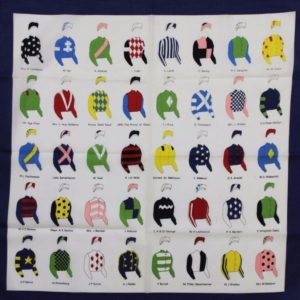
What Are Horse Racing Silks?  They help identify each horse in a race, the owner choosing their design such as shapes and colours. This consists of a top and cap. The cap may be a different colour and design from the top.

If an owner has more than one horse in a race they are often identified by a different colours cap such as white, red or blue.

The practice of using racing silks originated in England.

Horse racing silks are not a new idea and date back to the 12th century. However, many historians assign them around the date of 1515 when Henry VIII was king. In the 17th – 18th century is was more customary for jockeys to wear colourful silks.

You can design your own unique racing silks via a number of companies (such as Gibson Saddlers) however the guidelines for these are outlined by the British Racing Authority. This detail a set of 18 colours to choose from with a variety of shapes and designs. They can be made of crepe satin or pure silk.

Racing silks may be registered annually, or every 5, 10 or 20 years.

Some of the most famous horse racing silks have been sold.

It is reputed that the royal blue silks of Godolphin were originally in the ownership of Alan Bailey. Simon Crisford, now a horse trainer but originally racing manager for Godolphin, was said to have contacted Bailey to buy the silks for £500. However, following negotiations between the two Sheikh Mohammed wrote a cheque for £26,000. A lot of money in the 1980s, now seemingly a giveaway in these modern times.

What would your racing silks look like?


1 12 13 14 15 16 28