Which Group One races are run at Royal Ascot?
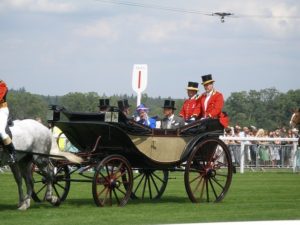 Royal Ascot is, of course, a highlight of the British sporting and social calendar. Remarkably, though, as recently as 1999, the Royal Meeting featured just three highest category, Group One races. Those races were the St. James’s Palace Stakes, Gold Cup and Coronation Stakes.
However, in the interim, several races have gained, or regained, Group One status and, in 2015, Royal Ascot was extended from four days to five to celebrate the Golden Jubilee of Queen Elizabeth II. At that point, a new Group One race, the Commonwealth Cup, run over six furlongs and restricted to three-year-olds, was added to the programme, making a total of eight in all.
In addition to the aforementioned races, the Prince of Wales’s Stakes was upgraded to Group One status in 2000, as were the Diamond Jubilee Stakes, formerly the Cork & Orrery Stakes, in 2002 and the Queen Anne Stakes in 2003. In 2005, the King’s Stand Stakes, which had previously held Group One status between 1973 and 1988, before being downgraded, became part of the so-called ‘Global Sprint Challenge’. As such, the five-furlong contest attracted a strong international entry, as a result of which it was upgraded to Group One status again in 2008.
 The late Alexander ‘Alex’ Scott was a racehorse trainer, who was shot dead by William Clement ‘Clem’ O’Brien, a groom at the Glebe Stud in Cheveley, Newmarket, on September 30, 1994. O’Brien was already employed at Glebe Stud when Scott bought the property in 1992, but developed a ‘deep resentment’ for his new employer. Following an argument during which he told Scott he could ‘stuff his job’, O’Brien lured him to a barn, where he shot him once with a single-barreled shotgun. Scott was just 34 years old. In July, 1995, O’Brien was sentenced to life imprisonment for the murder.
 Otherwise known as ‘vigorish’ – an Americanisation of the Russian word ‘vyigryshi’, meaning ‘winnings’ – ‘overround’ is the profit margin that bookmakers factor into a betting market, such that they make money regardless of the outcome. In a ‘fair’ market, the odds for each outcome, once converted to implied probability, should add up to 100%. In a simple coin toss, for example, the odds against tossing heads are 1/1 or ‘even money, which converts to an implied probability of (1/ (1+1))*100 = 50%; the same is true for the odds against tails, so it’s easy to see that 50% + 50% = 100%. However, to guarantee a profit, bookmakers offer odds that are shorter than they should be in a fair market.